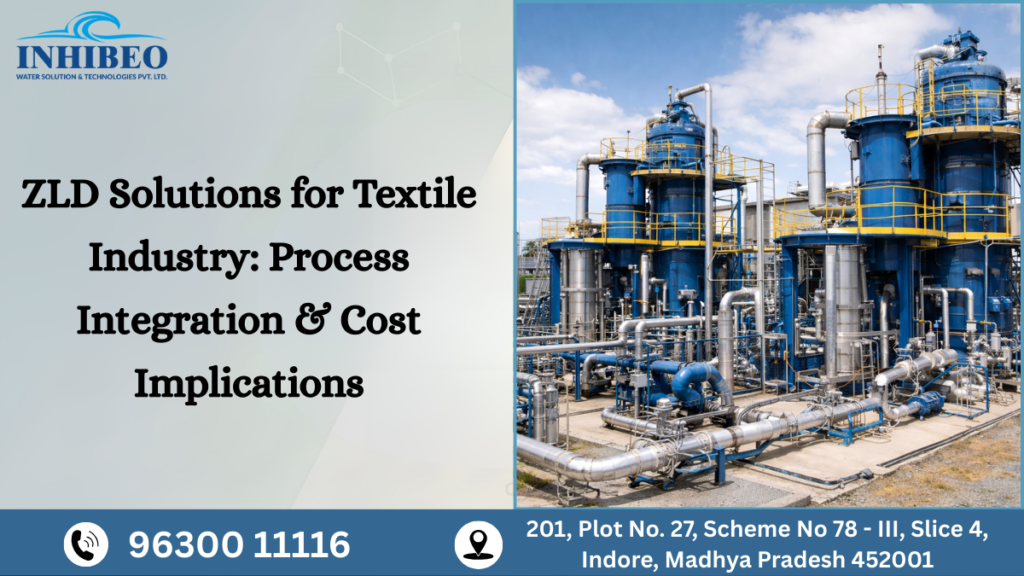

One of the greatest producers of industrial wastewater is the textile industry, and the effluent contains a high amount of dyes, salts, chemicals, and organic load. Since stricter environmental laws are enforced and increased pressure on conserving water, the adoption of a ZLD plant (Zero Liquid Discharge Plant) is a strategic requirement to consider, and not a formality that has to be complied with.
The perfect Zero Liquid Discharge Plant allows obtaining the maximum amount of usable water and gets rid of the liquid waste, which makes it a pillar of sustainable textile production.
Why ZLD for Textile Industry Is Critical
Textile effluent normally possesses high TDS, color, COD/BOD, and leftover chemicals used in the process of dyeing and finishing. Traditional systems of treatment are not able to recycle all water or attain discharge levels at all times.
Application of ZLD for textile industry can assist manufacturers:
- Get back 90-95% process water.
- Less dependence on freshwater.
- Get rid of discharge liabilities.
- Meet CPCB/SPCB requirements.
- Enhance ESG and sustainability objectives.
ZLD also safeguards downstream equipment by stabilizing water quality to be reused.
ZLD Process Integration in Textile Units
A typical textile Zero Liquid Discharge Plant can consist of several stages of treatment:
- Primary & Secondary Treatment – Equalization, pH correction, and biological treatment for COD/BOD reduction
- Tertiary Treatment – UF/RO systems for high-quality water recovery
- Concentration & Crystallization – Multiple Effect Evaporators (MEE) and ATFD for volume reduction and salt recovery
This combined method allows the industrial wastewater treatment to comply with the environment and help in achieving greater goals.
Cost Implications of a ZLD Plant
A ZLD system is costly depending on:
- Daily effluent volume
- TDS concentration
- Level of automation
- Energy recovery design
- Sludge handling requirements
Although the idea of capital investment might sound important, the long-term advantages are reduced cost in the procurement of water, reduced risk associated with regulation, and production continuity. ZLD can provide quantifiable ROI to many of the textile facilities by means of water reuse and stability of operations.
The appropriate ZLD Plant Manufacturer must be selected, as the quality of engineering will directly affect the cost of the lifecycle and system reliability.
Why Partner with Inhibeo Water Solutions?
Inhibeo Water Solutions is a reputable Zero Liquid Discharge Plant Manufacturer that provides custom-embraced ZLD systems in the textile and process industries.
Their solutions focus on:
- Industry-specific ZLD engineering
- Evaporation systems that are energy efficient.
- CPCB/SPCB-compliant designs
- Turnkey operation- design commissioning.
- Expansion of capacity in the future also be on a scalable system.
Inhibeo is a recognized zero liquid discharge system manufacturer, and thus, it assists textile manufacturers in attaining regulatory compliance within the framework of maximizing water recovery.
Final Thoughts
ZLD is not an option any longer when running textile operations, but rather a strategic investment in sustainability, compliance, and business resilience. The appropriate Zero Liquid Discharge Plant allows manufacturers to turn wastes to a reusable commodity and future-proof their activities.
A quality collaboration with an established ZLD provider can guarantee that your textile unit will comply with the current environmental requirements and water trends in the future.